

One project I’ve been spending some time on over the past couple months is rehousing my Glock 17 (registered pre-MD-ban SBR) into a B&T USW-G chassis. This has been a bit of a saga, but I think I’ve got the full picture now to share.
The USW-G is delightfully minimalistic as such things go, and not hard to install once you’ve gotten the hang of it. You field strip your pistol, insert the front end into the chassis, and then sort of pry the back half into the other half of the chassis. This require some upper arm strength, but any healthy adult should be able to pull it off (especially if you lever against a table or similar).
Once the frame is in, you need to put the slide on to the frame. The USW-G requires you to use a specific backplate that holds the charging handle. Installing this backplate is slightly more difficult than a normal Glock backplate, but still pretty simple with the “Glock tool” (that weird “rod with handle” thing). Once you have the backplate installed on the slide, you put the slide on the frame and ease it back just enough for the “big hole” you insert the charging handle to line up with the backplate. You put the charging handle in, and then finish putting the slide into place.
At this point, you’re basically done, except for tightening up the frame fit via a screw at the front of the chassis. There is apparently some art in just how much you tighten this screw, so I’d suggest finger tight and not trying to wrench it in too hard. It’s captured by a detent, so it’s not going to go anywhere. You want it tight enough that the gun doesn’t wiggle, but not so tight that you bend the frame (which will cause functional issues).

For sighting, you’ve got two options. The USW-G has a native Acro footprint interface, or you can use the included 1913 rail adapter and opt for something else entirely. I opted for using a Steiner MPS, which has an Acro footprint (and also works well with night vision).
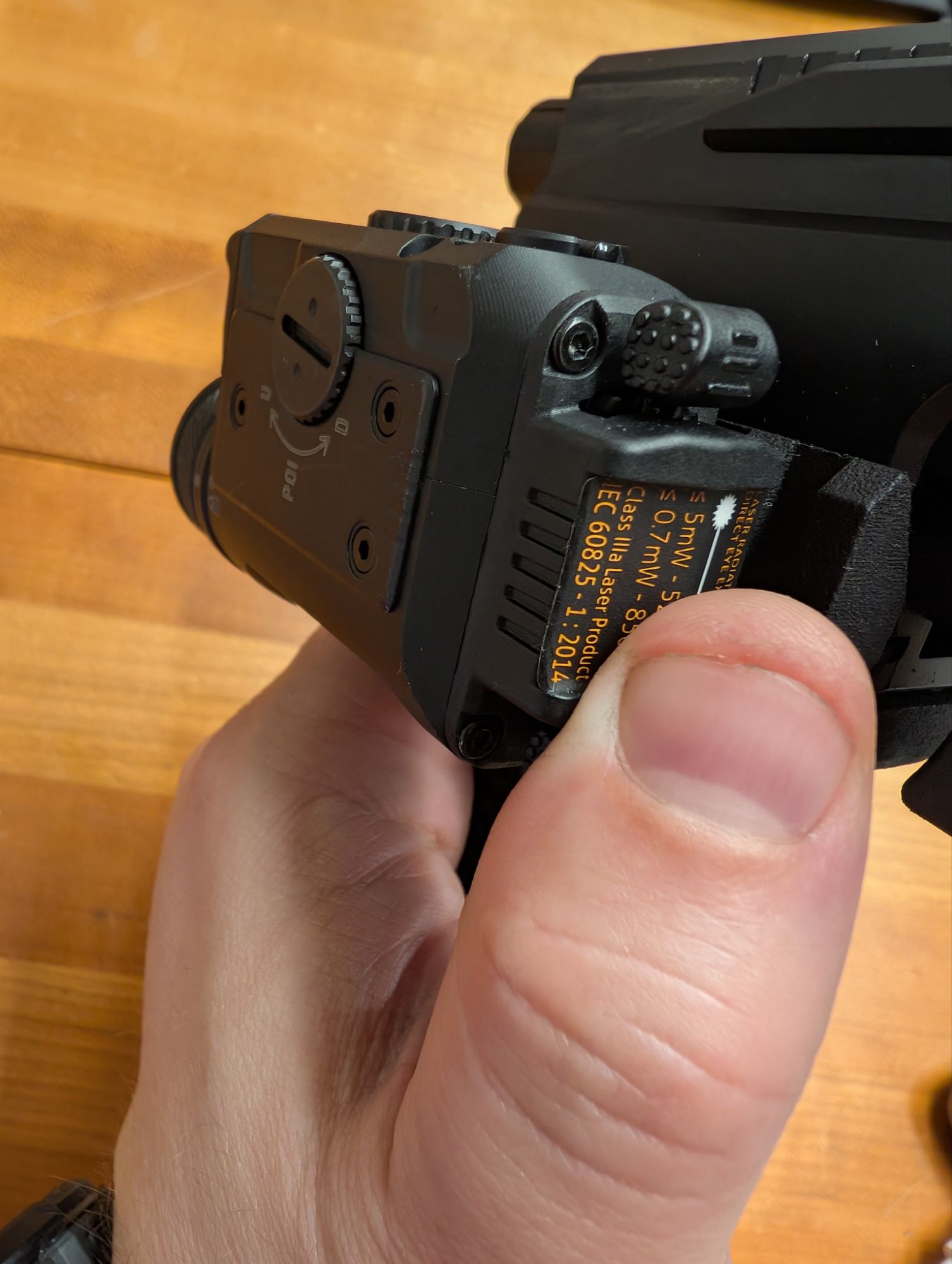
There is also a front 1913 rail you can use for accessories. I decided to get the CSM B&T USW Glock VFG, which isn’t too expensive, and provides a native side rail for a weapon light or MFAL. For that, I used a “facelift spec” RovyVon GL4 Pro with the improved switching (push to momentary). This gives me a lot of day and night capability while still retaining a very compact form factor.
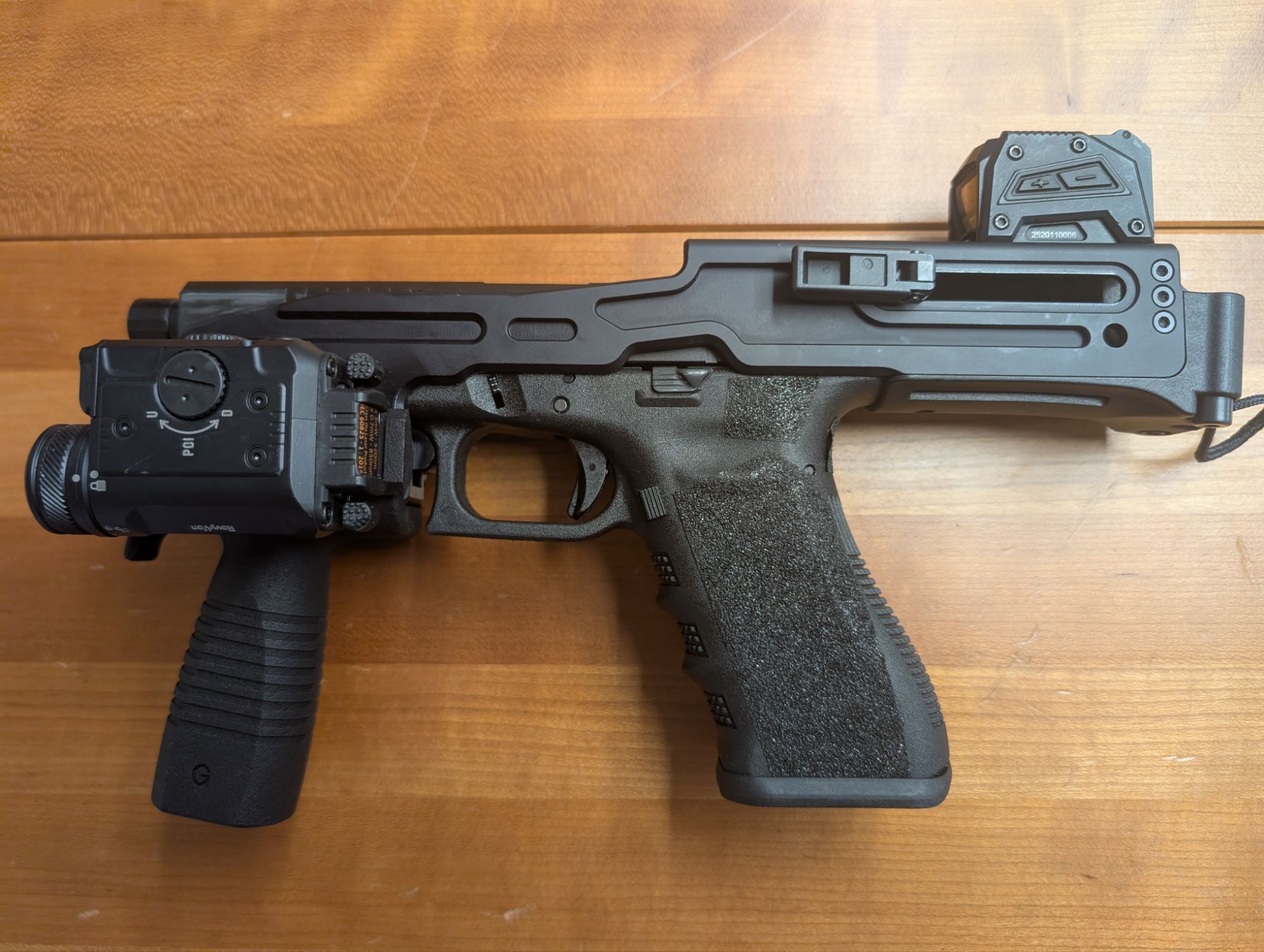
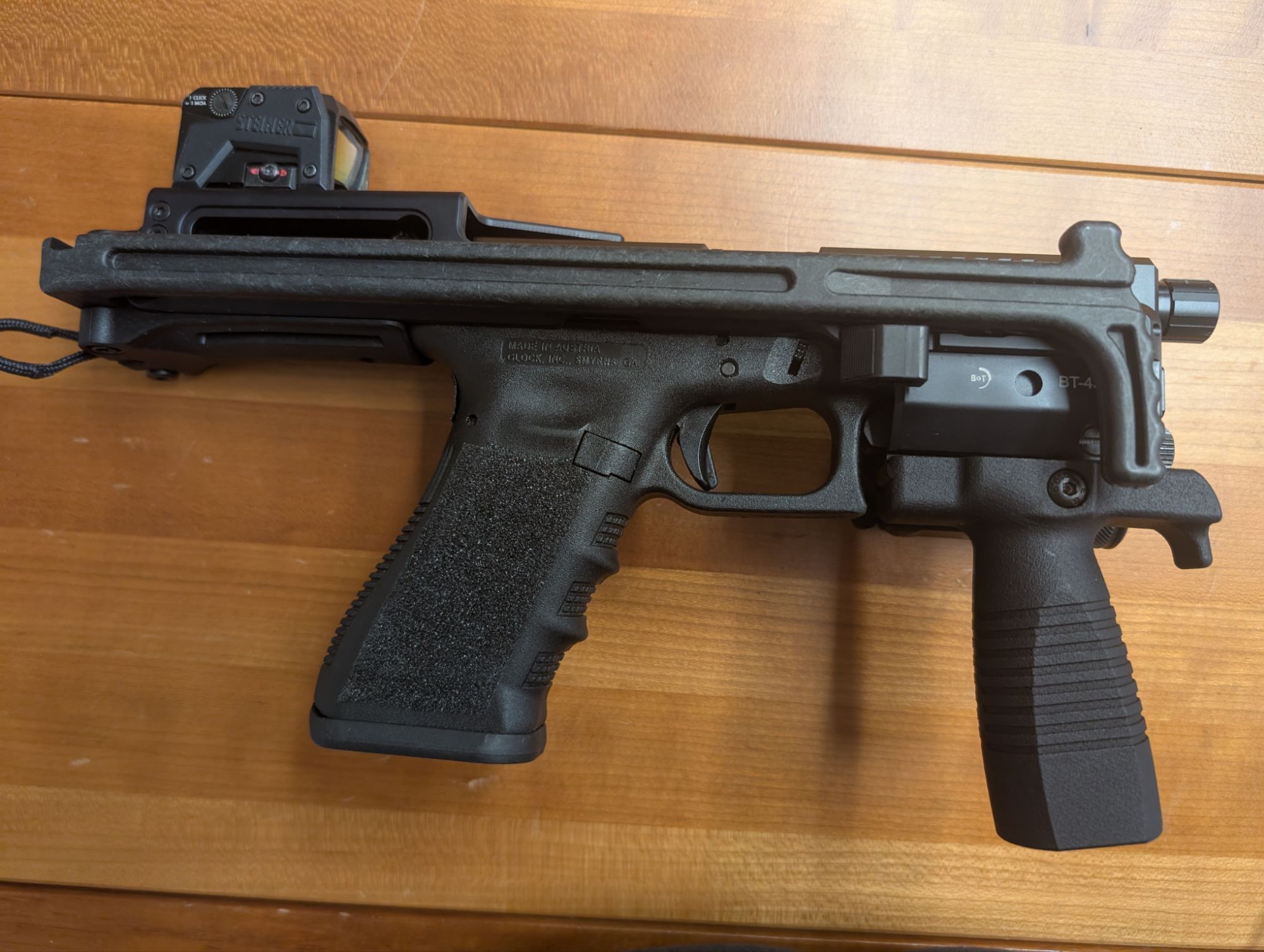


Weight with an Octane45k, VFG, GL4 Pro, and Steiner MPS: 3lb 9oz
Weight with VFG, GL4 Pro, and Steiner MPS: 2lb 15oz
Length with an Octane45k, stock unfolded: 27.75″
Length with stock unfolded (threaded barrel, no suppressor): 21.5″
Length with stock folded (threaded barrel, no suppressor): 11.5″
Pros and cons I’ve noticed so far in testing…
Pros
Return to zero and accuracy are better than I expected. I can drill out the center of a bullseye target at 18yds with this thing even after a re-install. I wouldn’t want to shoot a bullseye match with it, but it is convincing as an accuracy-enhancement solution. Unlike the KPOS G2, accuracy does not seem to be an issue, probably due to the tight fit between the front of the chassis and the frame.
It is absurdly compact. A lot of “pistol to PDW” solutions miss on this, but the B&T USW-G is under than a foot when folded, and less than 3lbs without a suppressor. The Flux Raider is comparable, but no “real” PCC even comes close.
It shoulders really naturally. You don’t need to stuff your cheek into the stock to see through the sight.
The charging handle is pretty well-designed. It folds! It can be mounted on either side of the gun! It feels sturdy! It’s simple! It does reciprocate, but that’s the nature of the beast.

It works great with suppressors. I had no issues at all using an Octane 45K with it. It’s a bit gassy, but certainly manageable.
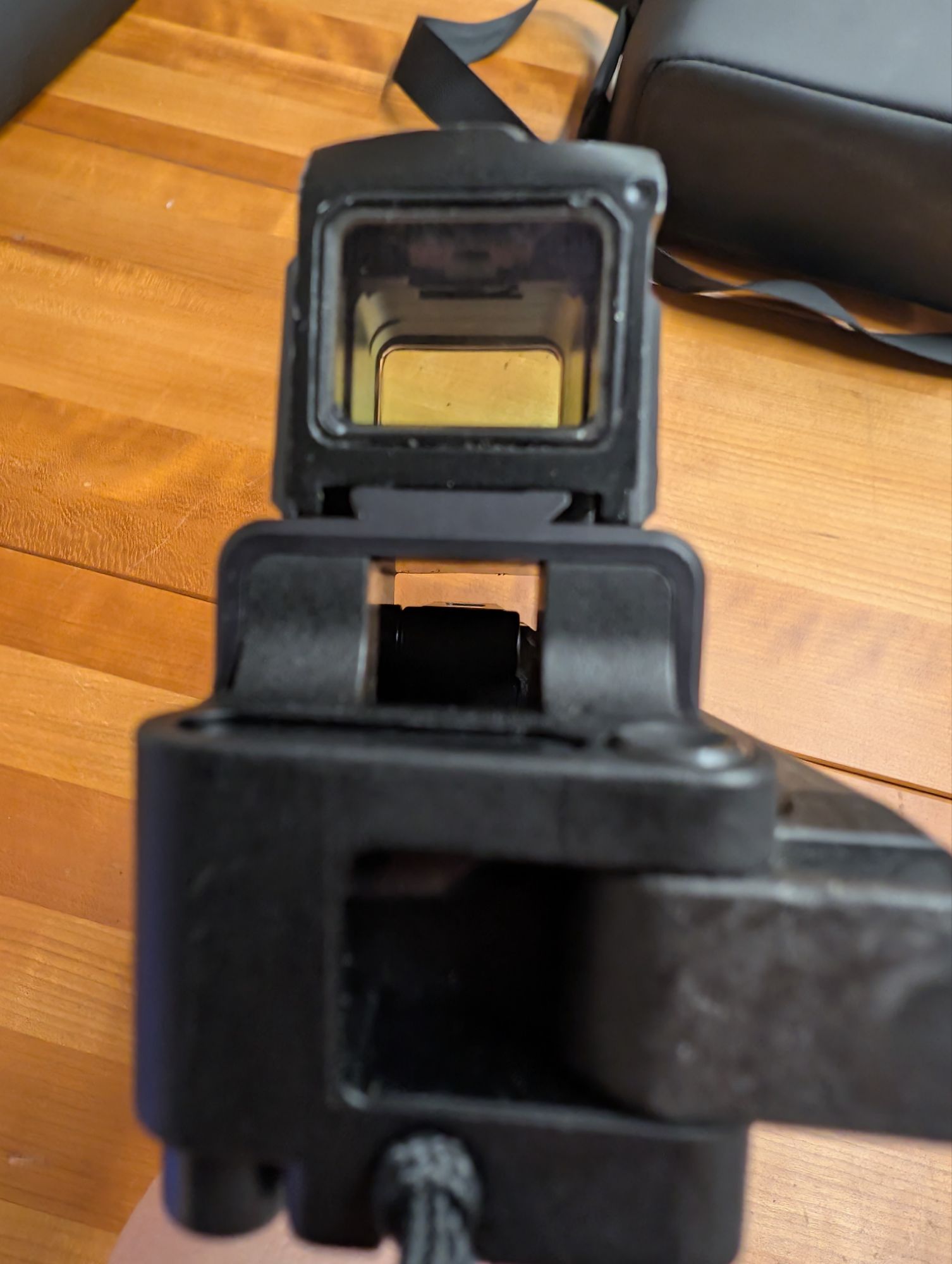
It does have a port to view irons in a pinch. You won’t be able to use it with the stock easily, so this basically lets you use your gun as a pistol again. I don’ t doubt this is unwieldy, but it is helpful if your optic dies and you need a sighting option.
Cons
The slide will bind and cause malfunctions if you’re holding the gun too tight. This is a problem with all Glock chassis systems to some degree (excepting maybe the ENDO stock, which has two points of contact), but it was very obvious on the USW-G. If I pulled the pistol grip hard into my shoulder, cranking the grip, the slide would bind on the return and not go into battery every time. Pulling in with the VFG was somewhat less prone to doing this, and a light pull into the shoulder with a neutral grip turned in a very reliable performance. Putting a suppressor on the front of the gun helped keep muzzle rise to basically nothing, so you don’t really need to pull in hard anyways. This kind of neutral shooting hold may not be natural in a high stress situation. I don’t think this problem is related to the tension in the front chassis screw being too tight, but YMMV.
It is very easy to test this problem yourself. Just lock the slide back, put a hand on the pistol grip, and shove the gun hard into your shoulder with that hand. Take your other hand, release the slide, and you’ll see if the gun goes back into battery. It took me a while to realize what was going on when I was having inexplicable live-fire reliability issues I couldn’t easily duplicate at home.
There’s no manual safety. The total lack of a manual safety is problematic (to say the least) for carrying this slung with a round in the chamber. This is admittedly a hard problem to solve, but might have been doable with something like the KPOS’ folding/extending VFG (note: the KPOS VFG will not work on this gun – I tried it).
There’s no holster solution for weapon lights or VFGs. The USW-G was clearly designed to be carried in a holster (which they make!). Unfortunately, there’s no holster solution for VFGs and/or weapon lights, which is problematic when the gun can malfunction when used as designed.
There’s no native side rail interface. It is really bizarre the no provision was made for screwing a side rail into the gun given that every after-market VFG seems to provide this functionality. Having it mounted to the VFG seems like a stacking tolerance issue.
The stock is a cheese grater on your shoulder. I took my shirt off after a shooting session where I was pulling in hard, and I had little lines from the stock on my shoulder. I don’t know who at B&T decided that a bit of rubber padding was totally uncalled for, but it’s brutally uncomfortable given how narrow the stock is.
Overall
Basically, there’s no free lunch. The USW-G chassis improves a lot on accuracy, it has good ergonomics, it looks awesome, and it is plenty compact, but it is both impossible to safely carry slung and loaded (due to no manual safety), and prone to malfunctions from a holster in high stress situations (since you can’t mount a VFG or suppressor while using the holster, and the gun is only controllable through a firm grip). I think you could use it as a backpack gun if you used one of those trigger safety blocks, but on the whole, I’m not sure the practicality factor is very high.
Ultimately, it comes down to the Glock just not being a very good starting point for something like this. FCU chassis platforms won’t have the same problem with slide binding (since the rails are one-piece and built in to the FCU), and most FCU platforms have some sort of provision for a manual safety. Even for the ones that don’t have such a safety, having the whole grip to work with gives a lot better options for including one (even if it’s just blocking the trigger ala the Flux chassis method).
At this point, I’m just going to accept that it’s a fun gun for night shoots, put a Flux Ripcord sling and a trigger block on it to make it usable as a go-bag option, and move on. If I ever get the itch to go down the pistol-to-PDW rabbit hole again, my next project will be a Flux Defense P320 setup using a spare FCU.
 The Hebrew Hammer