All posts by David Zakar

Saiga 12 SBS Night Vision Configuration

Early on in my gun-owning journey, I bought a Saiga 12 and converted it to a 13″ barrel SBS. It’s a slick gun, albeit I think it’s been since eclipsed by some other contenders (especially the VEPR 12 and RIA VR80). I still enjoy shooting it as the opportunity presents.

Ever since I got into the night vision game, I’ve been a bit obsessed with the idea of a night vision-oriented shotgun. I don’t think the Saiga 12 the BEST choice (rock-and-lock in the dark is rough with shotgun magazines), but I think it’s respectable, and it’s what I’ve got. However, in order to get my Saiga 12 SBS into a night vision ready mode, some upgrades were in order.

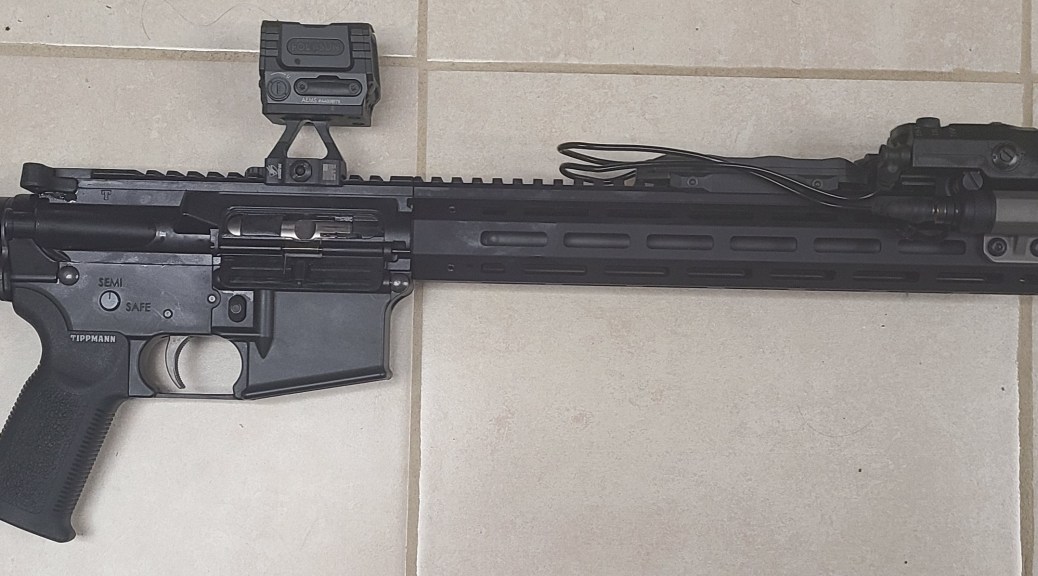
First, it had an old-style Chaos tri-rail. There’s nothing wrong with that per se, but I felt that moving to MLOK would give me a lighter gun to compensate for the stuff I was about to bolt on to it. I went with the KS-12 TRSS handguard, which wasn’t overly expensive and fit my SBS tightly (always a good thing when you’re about to mount a laser).

Next, the optic needed an upgrade for passive aiming use, with better light transmission characteristics and night vision brightness modes. I had an AEMS Core (green) optic on a PCC I wasn’t using much, so I bought a low mount for it and put the AEMS on the Midwest Industries side rail sight mount. This gets it nice and high, but not so high as to be obnoxious when not using night vision. The AEMS is widely regarded to be the next best thing to an Eotech E/XPS3 for night vision use.

Then… lights and lasers. I wanted to retain the shotgun’s white light ability, thus the solutions needed to be able to go in the visible and IR spectrums.

For the laser, I decided to go with the Holosun LS221G I had previously bought for my .300BLK SBR (and replaced with a Somogear PEQ-15). While it’s not optimal, I decided to mount it on the right side of the handguard. I didn’t have a top rail, and for reasons you’ll read about later, I didn’t want to put it on the bottom rail. One funny note about the LS221G is that the turrets are all labeled for side mounting.

For the light, I decided to go with a classic: the Surefire KM2-C “Vampire” head on a Surefire body with a Surefire UE tailcap, mounted offset from the bottom of the handguard. This would give me good IR and white light flood, which is all I really need out of a shotgun.

Finally, for the switch, I used a leftover Unity TAPS Sync V4 switch, which gave me the choice of light+laser or just laser. Since both the laser unit and the light could be individually configured as white light or IR, this gave me a lot of flexibility in how I could configure the whole system – and would eliminate the possibility of negligent white light discharges. Very handy!

This setup worked really well. However, when I put my Salvo 12 on the gun, the suppressor blocked the KM2-C. The Salvo-12 is a rather oblong suppressor and has a lot of mass below the barrel – fine on a tube-fed shotgun, inconvenient on a mag-fed shotgun. This got me thinking: how could I build this gun so that I could further offset the light?

The solution I wound up with was to utilize a knockoff fusion hub with an offset rail mounted to the top of it, on the right hand side of the handguard. I then mounted the LS221G to the rail on the hub, and the light straight to the offset portion of the hub (up and towards the centerline).

This pushes the light out of the way of the laser unit and the suppressor, while not blocking the field of view for the optic. It looks weird, but it works great. The suppressor does cause some shadow in the light beam, but it seems pretty usable in general. Unfortunately, since I don’t always run a suppressor on this gun, I was reluctant to mount the light further forward using a wing.

I ran the shotgun at action shooting practice, and there was no discernable zero shift. That’s a testament to the LS221G, but it’s worth noting that I was also shooting slightly-spicy birdshot, not hard-kicking 3″ 000 buckshot. The recoil is pretty anemic with the suppressor on; you can run this gun pretty fast if you want to.

I’ve also run it at night. And it’s a ton of fun. Reloads suck in the dark, but just shooting it until it runs dry and transitioning to pistol is great. The IR setup works really well for what I need (which is shotgun distances).

Obviously, this is a for-funsies gun for the most part. Yes, I could press it into home defense use, and I’m sure it would excel, but it’s mostly there as an oddball gun to run at night shoots to see how a shotgun can break stage setups. I may send it out to Dissident Arms at some point for a VEPR magazine conversion to aid in reloads.
My experience with ACE

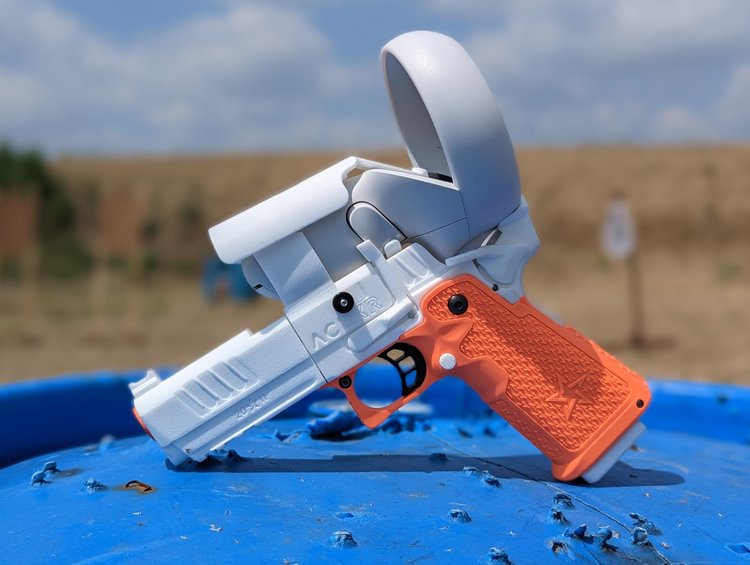
I have been spending a LOT of time doing dry-fire using ACE for the past few months. ACE is essentially a shooting simulator application plus 2011 shell for your Quest 2. There is no recoil simulation, but it occupies an interesting spot between dry-fire and live-fire due to the feedback you receive during the course of fire.

image stolen shamelessly from ACE’s website

The hardware shell is extremely good. I wouldn’t call it perfect, but it feels and mostly behaves like a real gun. There is software tuning that alleviates common issues (mostly for reloads for me), and while the trigger is not quite as nice as a real one, it’s certainly good enough for dry-fire usage. All of the controls of a real 2011 are present, and it fits in real 2011 holsters. I use an Alpha-X holster with the BUL SAS II insert, and it fits quite nicely.

The software is similarly excellent. It is easily the best competitive shooting simulator I’ve had the opportunity to try (and I’ve tried a few), and the overall experience is very realistic. Where the ACE experience really exceeds static dry-fire is in how you get realistic feedback. You will not see your bullet holes on paper targets that aren’t in your face. Steel doesn’t fall if you hit it in the wrong spot. Moving targets move at the rates you see in real life. Basically, ACE avoids the pitfalls of laser trainers and gives you accountability that is sometimes lacking in classic dry-fire.

The limitations are really from the Quest 2’s hardware: the brightness floor and ceiling is not enough for an ideal red dot presentation (no HDR or Dolby Vision, basically), and the refresh rate is not as fast as your brain can process (but it’s reasonably close). This is early access software, so I expect that we’ll see some workarounds as time goes on, but the fact remains that VR is not going to perfectly simulate real life, and none of this is a deal-breaker. In a way, the dot visibility issues actually encourage you to NOT get overly focused on the red dot and to trust/build your index.

The stages are a mash-up of USPSA classifiers, Steel Challenge stages, and some outlaw designs. I like the variety, which also includes a long-burn steel stage, some carnival props, and even moving targets. There’s also a static target range and a 360 degree drone shooting challenge. I sympathize with the developers’ conundrum in that while I would personally prefer classifiers and stages that I’d see at matches, I can see how more mainstream users would be looking for something else. The room scale stages are a special treat, and I cleared out my basement just to be able to shoot them with real movement.

ACE isn’t cheap ($200 as of this writing), but I don’t really regard it as overly expensive as training tools go. Gaim is at least twice as much. I saw substantial improvements in real-life shooting performance from using ACE, and the weekly updates it receives only make it more useful. I feel like the shooting community has become a bit too cynical about new training tools, and if there was ever one to take a look at, ACE is it. I highly recommend it if getting out to the range for regular live-fire action shooting practice isn’t an option, and classic dry-fire has gotten a bit stale.

Masada Slim Quick Review

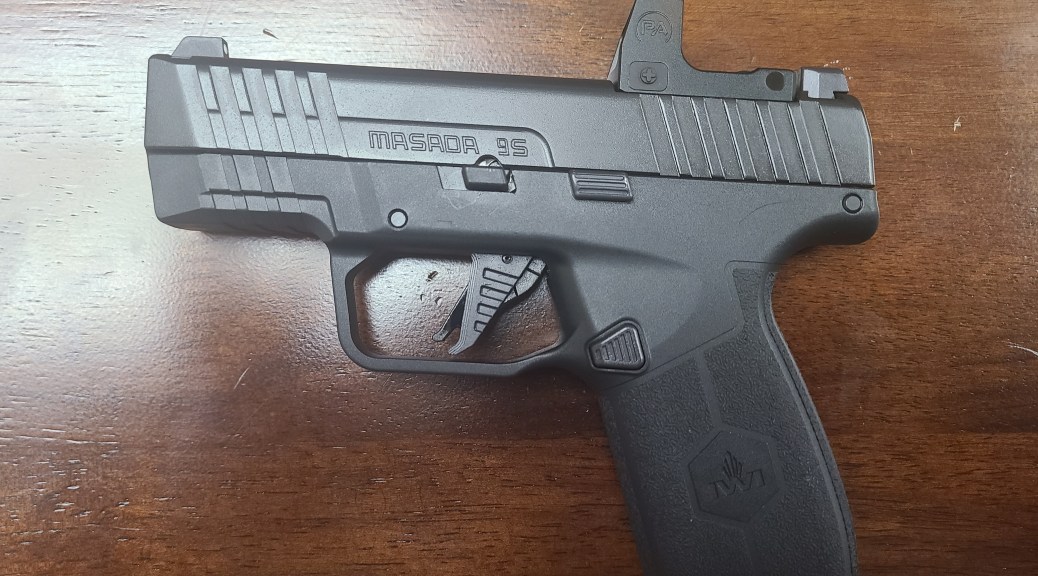
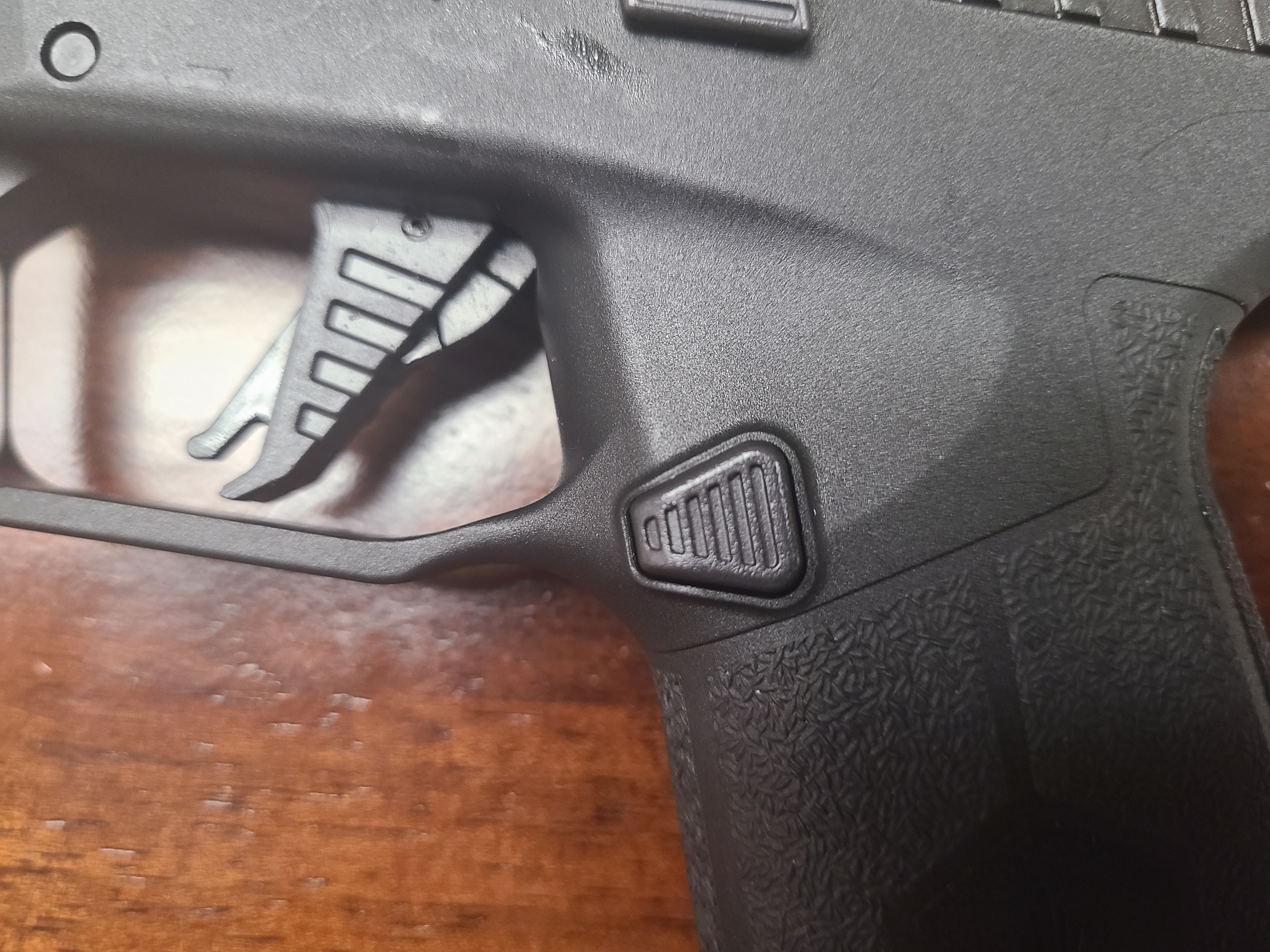
A buddy of mine was selling a certificate for a Masada Slim. I had passed on the original IWI Masada because I didn’t want to deal with the proprietary magazines. The Slim, on the other hand, uses standard CZ-75 / Tanfoglio small frame magazines, which is much more appealing to me as a shooter – and the Israeli connection obviously puts it in collector territory. I bought the certificate from him, and got it from IWI. Here are some thoughts after shooting it a bit:

  1. Size-wise, the Masada Slim is pretty similar to a Glock 19 with a Glock 26 slide. It is a comfortable gun to hold.
  2. The Tanfo small frame / CZ mag compatibility is a nice feature if you like to carry a larger mag on you for your reload. Most of the online reviews don’t seem to have tested this, so I’m here to tell you it works great. No problems, except that the 13rd Tanfo mags don’t seem to fit (14rd CZ mags do fit).
  3. It does not seem to be ammo sensitive at all, and is quite reliable. Zero failures so far.
  4. Sight return was shockingly good. I shoot competitively, I’m used to gripping my gun. This gun delivered. I fired, and the sights were pretty much right back to where they were with no intervention by me.
  5. The iron sights suck. No other way to put it. Good enough for A-zone stuff, but too big with the hold way too high for smaller stuff like plate racks. I’m not saying it’s unusable, but I’d pretty much kill for sights that gave me a proper center hold and a smaller front sight. (The fact that nearly zero reviewers seemed to mention this makes me wonder how much payola is going on.)
  6. The trigger is acceptable for a carry/duty gun. Lots of take-up, good break. Not too heavy or light.
  7. Balance-wise, it’s a bit top-heavy. I don’t think this has much impact when shooting the gun.
  8. Take-down sucks. It’s technically tool-less, but good luck getting the pin out without pliers. This isn’t a deal-breaker for me – I’m not really doing field strips outside my house – but it’s a negative.
  9. Controls are intuitive, and I didn’t find myself having trouble with the mag release or slide lock.
  10. Oddly, there is no accessory rail. I don’t think this is a deal-breaker, either, but it’s unusual to see in a gun in 2023.

If this became the mainline Masada platform, it’d be a smart move by IWI. Jericho mag compatibility is a big deal, and the rest of the gun (excepting the sights and take-down) is pretty solid. I wouldn’t rush out and tell people to buy this instead of a P365X, but it holds its own, especially with an optic so you don’t need the horrible iron sights. (I wound up using a cheap Primary Arms sight.)

As an interesting aside, it almost fits the IDPA BUG box. If you were willing to chop the grip and use the 13rd Tanfo mags, you might be able to pull it off. Unfortunately, without spare grip modules on the market, this is too much of a one-way trip to risk it.

Tippmann M4-22 Elite Review

Something I struggle with is the balance between cost and training. 22lr is really good for some things. Gun handling, transitions practice, ready-ups, long-range-at-short-range, etc. I spend a large part of my year shooting 22lr with the kids on a regular basis. A hundred rounds of 22lr is a bit over five bucks (at current prices). A hundred rounds of 223 is more like $25 (if I reload it). That’s a big price difference!

I really enjoy shooting under night vision during the fall and winter (post-DST), and having a way to do it more cheaply was a priority. Another consideration is that I also shoot a fair bit of outlaw falling steel, and a gun with a reliable high-cap magazine would be terrifically useful for that. Enter the Tippmann M4-22 Elite.

Continue reading Tippmann M4-22 Elite Review

A quick review of the Armanov Quick Loader

As my readers know, I do a lot of 9mm reloading to keep myself (and my son) shooting. It’s not quite the absurd levels that some competitive shooters do, but I can easily load 10k a year. One thing I’ve made a practice of doing is gauging every single round I load. This avoids a number of potential issues, and perhaps more to the point, gives me faith that the rounds I put in the gun will work every time.

Gauging rounds manually is slow. In fact, it’s about as slow as loading them in the first place. The Armanov Quick Loader fits on top of the Armanov “hundo-style” gauge to help get rounds in there more quickly. Does it work? Read on.

Continue reading A quick review of the Armanov Quick Loader

Kestrel KST1000 Shot Timer Review

My review of the AMG Lab Commander shot timer continues to be one of the more popular articles on this blog. There’s good reason for that: the Commander, while not a perfect timer, still sets the standard for size and usability. I use it weekly during the shooting season.

However, as mentioned, the Commander is not perfect. It’s not terribly loud. The waterproofing aspect has been known to be an issue. There’s no backlighting. Seeing the time while you’re wearing it is awkward, and there’s no integrated belt clip. None of these are a big deal, and are weaknesses shared by other timers. However, they did make me want to look into other timers.

Ever since I saw the Kestrel shot timer at SHOT Show in 2022, I’ve wanted to get one. While it’s certainly a fairly large piece of hardware, it seemed like it was designed to address the shortcomings of other shot timers. Did it? Read on.

Continue reading Kestrel KST1000 Shot Timer Review

Active Response Training Close Quarters Gunfighting Class AAR

The last class I took with Greg Ellifritz was his knife class in 2019, which I absolutely loved. In fact, it convinced me to carry a knife on me as much as possible, which was something of a lifestyle change. This positive experience made me really want to take his Active Response Training ECQG class. Well, COVID got in the way and delayed things, but the stars finally lined up, and I was able to enroll in the class.

What did I think? Read on.

Continue reading Active Response Training Close Quarters Gunfighting Class AAR

Somogear PEQ-15 Review

As you’ve seen in my more recent posts, I’ve been getting into the night vision game lately. Ironically, I’d say I’m still spending a lot more time doing competition shooting, but at least the two interests tend to have some skills overlap.

One of the things you quickly discover about the night vision world is that active aiming is awesome, and good IR illuminators are shockingly expensive. You can get a usable IR laser for reasonably cheap ($200-$300 for a Holosun LS117IR), but an IR illuminator that can really throw? That’s going to cost you.

But… what if there were a $250 unit that could give you co-aligned visible and IR lasers along with a reasonably good (but not amazing) IR illuminator? Well, maybe there is. I bought the Somogear PEQ-15 to check out whether this Chinese company broke the code. Did they? Read on.

Continue reading Somogear PEQ-15 Review

Gemtech GVAC Uppers Available

I got an email from Brownells that they Gemtech GVAC uppers are now available.

I know most of you won’t care, BUT these are extremely exciting because they incorporate Gemtech’s bore evacuator technology. This makes gas much less likely to come back into your face, which is a common issue with suppressed shooting (especially if you are using a higher blowback pressure suppressor). Gemtech’s Integra uppers featured this technology prominently; unfortunately, the reflex-style suppressor made the handguards far too hot to hold in short order. If you are making a rifle that is going to spend most of its time suppressed, this upper seems like a really great idea.

A Quick PSA about the Vortex Defender MRDS

I’ll make this post short. I bought a Vortex Defender MRDS to replace a Romeo0 on my backup P365X carry gun. It came, I took it out of the package, and put in a battery to function-test it before I did anything permanent.

It has a TERRIBLE refresh rate at anything other than max brightness. Like, I could cant the optic up and down at a very moderate rate and see a trail of red dots with substantial gaps between them. I have literally never seen this problem before, including on some really cheap optics. I am not sure what caused Vortex to make this design decision, but it was a terrible idea. Unfortunately, higher brightness levels caused substantial halo with the red dot as well. (On the plus side, it got very bright.)

I returned it. The 507K is still the RMSc footprint optic to beat. I thought everything else about the Defender seemed pretty solid, but those were deal killers for me. Keep in mind that this is coming from a guy running two UH1s, two Razor LPVOs, and two Razor RDSs. I am perfectly happy buying Vortex. But the Defender… not so much.