All posts by David Zakar

Making your own PVS-14-style irises

After messing around with night vision a bit, I discovered that the amount of light you let in makes a huge difference in your ability to see detail at varying distances in different light conditions. There are a couple ways of dealing with this:

  • Flip-up lens cap systems, such as the Phokus Hoplite or the improved Butler Creek setups (sometimes involving 3D printed components)
  • Irises

My RNVG came with a flip-up system with a 3D printed “shutter”. It works well enough, but is not up to hard use. It’s also the wrong color, which offends my aesthetic sensibilities. I knew in my heart that I wanted an iris system. The problem with irises is that the go-to Matbock Tarsier Eclipses are hugely expensive – as in $250 each. While I’m not afraid of spending money when it’s called for, $500 for a couple irises seemed a bridge too far, especially when there had been some complaints that they were so tight that adjustment frequently adjusted focus. If I were using these in a duty context, sure, I’d buy the Matbock solution and then expense it to my unit.

However, with the power of the internet, I discovered there was a far cheaper way of approaching this problem. Here’s the recipe I used:

If you’re in a hurry, you can get the same irises off Amazon for 50% more, but if you use my recipe, it’s ~$50 for each tube. Besides the much more acceptable cost, one thing I really liked about this solution was how I had more finely-grained control over light, and how the sacrificial lens was screwed in (vs sandwiched in my previous setup). The amount of force needed to turn the diaphragm was also just right, and did not affect focus. They also look super cool, and if they get damaged, it’s a LOT less money that I’m out. I was quite impressed with the amount of thread engagement that each piece of this solution also had – the iris and lens are not going to be coming off by accident.

Cosaint COS11 Review

Sometimes, you’re seized by the desire for something a little novel. I had been investing heavily in BUL 2011s (and loving them), and wanted a similar sort of gun for shooting USPSA Single-Stack and IDPA CDP. Of course, USPSA Single-Stack only allows single stack 1911 magazines, so this limits your choices a bit. I initially went looking for a Staccato R in .45 Auto; when this didn’t pan out, I found a different option: the Cosaint COS11, which is very similar in many ways.

Continue reading Cosaint COS11 Review

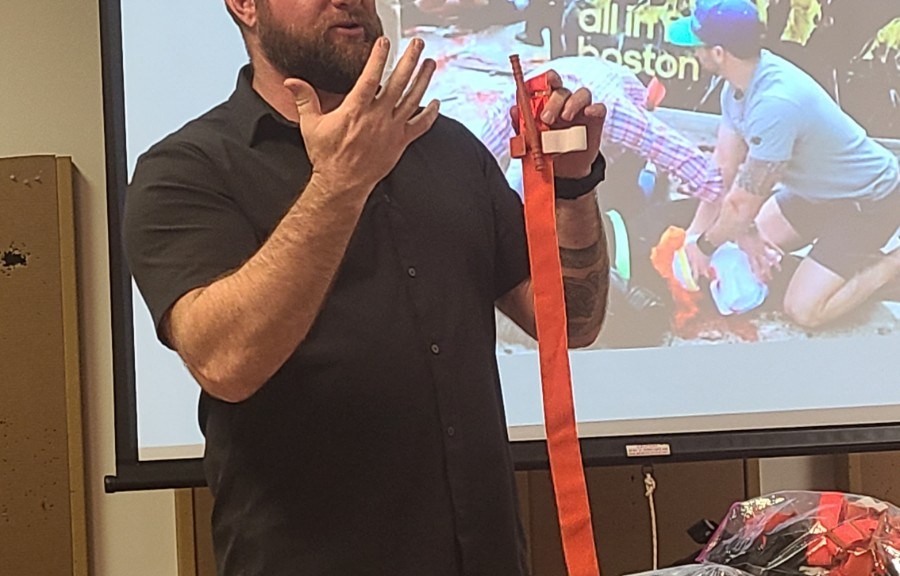
Green Ops M.A.R.C.H / TCCC Training AAR

Any time there’s a good medical class offered, I try to clear off my schedule so I can take it. I know shooting is more fun, but the reality is that I’m a lot less likely to shoot someone, and a lot more likely to need to treat an injury.

I’ve taken CPR and Stop the Bleed classes, but I’ve never done a TCCC-oriented course. When I saw that Green Ops was offering one, I made sure to sign up. What did I think? Read on.

Continue reading Green Ops M.A.R.C.H / TCCC Training AAR

Sometimes you do beat those odds

As mentioned in passing in other posts, I bought a Smith & Wesson R8 revolver about a year ago that I have basically been using for messing around with OSR and low-light shooting. Reloading 357 Magnum (at 38 Special pressures) is a good excuse to use leftover powder that I am uninterested in stocking longterm (Bullseye, Unique, etc.). Nothing wrong with that, but as any reloader can tell you, swapping out calibers on a progressive press is typically an annoying affair. I also find that 9mm moonclips typically work much better than 357/38 moonclips due to cartridge length. You can see where this is going: I like the R8 in 357 Magnum, but I’d like it a lot better if it were in 9mm.

Continue reading Sometimes you do beat those odds

Meprolight Mepro 4X-CHV Day Scope Review

An optic that has always interested me was the Meprolight Mepro 4x Day Scope. This is the ACOG competitor that Meprolight released a few years back, and discontinued recently. This had led them to becoming a little cheaper, and thus now within the realm of “things I can buy without it being a major financial decision”.

I’ve got mine mounted on a Tavor SAR… read on for what I thought of it.

Continue reading Meprolight Mepro 4X-CHV Day Scope Review

What is a 2011 vs a double-stack 1911?

Words have meanings, and the 2011 vs double-stack 1911 terminology is extremely confusing to many people… hence a lot of misuse. With a number of new entries coming into the market, I thought a refresher would be in order.

A double-stack 1911 is literally just that: a 1911 with a wider grip, and no other structural changes. Examples of these include the Para P18, BUL M-5, and RIA TAC HC. This necessitates certain parts differences (trigger bow being a big one), but the parts differences may vary from model to model; for example, Para P18s use different grip panels to hide the trigger box near the grip safety, vs the BUL M-5 which has a very specific grip safety with wings.

2011 is a registered trademark of Staccato (nee STI), but it is the generally accepted term for a 1911-like pistol that has a steel module with rails and a pair of grip bushing as its serialized part. The key word here is modular; the grip can be changed out separately, and is often polymer. Examples of these include the Staccato P, BUL SAS II, and Springfield Armory Prodigy. There may be certain parts incompatibilities (BULs use different grips and magazines) between them, but they usually use about the same parts you’d see in double-stack 1911s. One key thing to understand is that not all 2011s are double-stack. The Cosaint COS11 and Staccato R are 2011s that use single-stack 1911 magazines.

So… now you know. Don’t say 2011 when you’re look at that RIA, and don’t say double-stack 1911 when you’re looking at a Staccato P. 🙂